A shipment of industrial pumps is ready to leave port. The purchase order lists 240 units, priced in US dollars on CIF terms. The pro forma invoice agrees, but the beneficiary account on the supplier's payment instruction differs by one digit from the one on file. The commercial invoice gives the consignee's address as "14 Harbour Road"; the packing list says "14 Harbor Rd., Unit 3". Each document looks correct on its own. Read together, they raise three questions that must be answered before the goods, the money or the paperwork can move.
This is everyday reality in global order processing. McKinsey notes that documentation for a single shipment can run to 50 sheets of paper exchanged with up to 30 stakeholders. Its analysis also indicates that the bill of lading accounts for between 10 and 30 percent of total trade documentation costs (McKinsey, 2022). Every handoff is a chance for a shared fact, such as a quantity, a currency, a bank account or an address, to drift.
Digital Documents Still Need to Agree
In February 2023, members of the Digital Container Shipping Association (DCSA), representing major container carriers, committed to converting 50% of original bills of lading to electronic bills of lading (eBLs) within five years, with full adoption targeted by 2030 (DCSA, 2023). Despite this commitment, global eBL adoption remained at just 12.8% in January 2025. As a result, order processing will continue to rely on a mix of PDFs, scanned documents, ERP exports and emailed instructions for years to come.
But even when every document in the file is digital, the drift does not disappear. A digital document that disagrees with another digital document is still a problem; it simply arrives faster. The cost of that disagreement is real.
Why Manual Cross-Checking Cannot Keep Up
Most teams already check their documents, usually by having an experienced coordinator compare files side by side. That approach has clear limits.
Every document has a different author. Procurement issues the purchase order; the supplier's sales and finance teams issue the pro forma invoice and payment instructions; and the carrier issues the bill of lading. Each author is responsible for their own document, but nobody owns whether the documents agree.
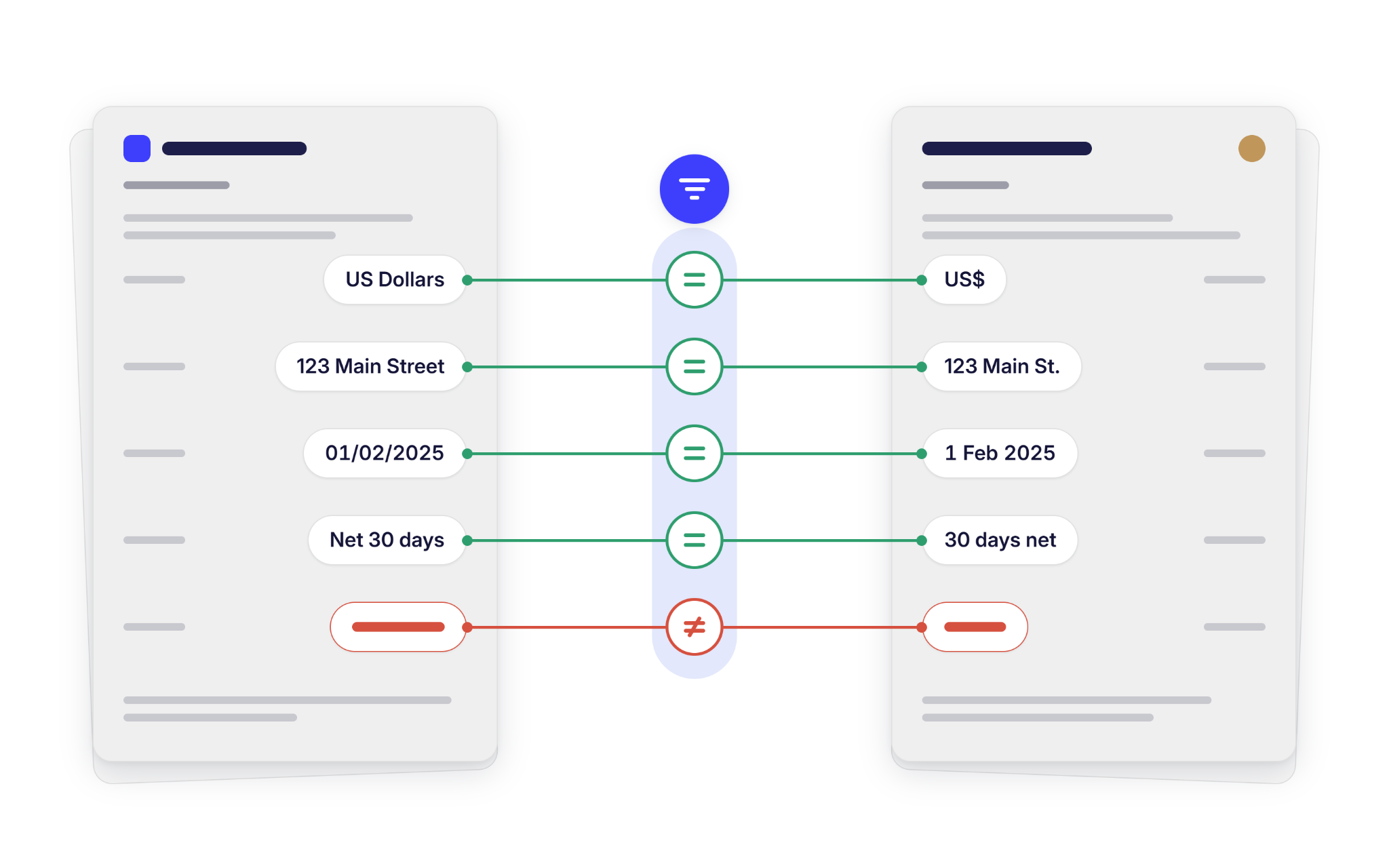
Equivalent facts also look different. "USD", "US Dollars" and "US$" mean the same thing, while "01/02/2025" can mean 1 February or 2 January depending on the country.
Then there is scale. Five documents with 20 shared fields imply 200 pairwise checks, and phased deliveries add legitimate differences that hide legitimate errors. Even capable teams end up relying on memory for much of it.
Teams need a way to quickly and consistently confirm that every document in an order tells the same story. That is why we built DocValidator.
Introducing DocValidator from Kainovation
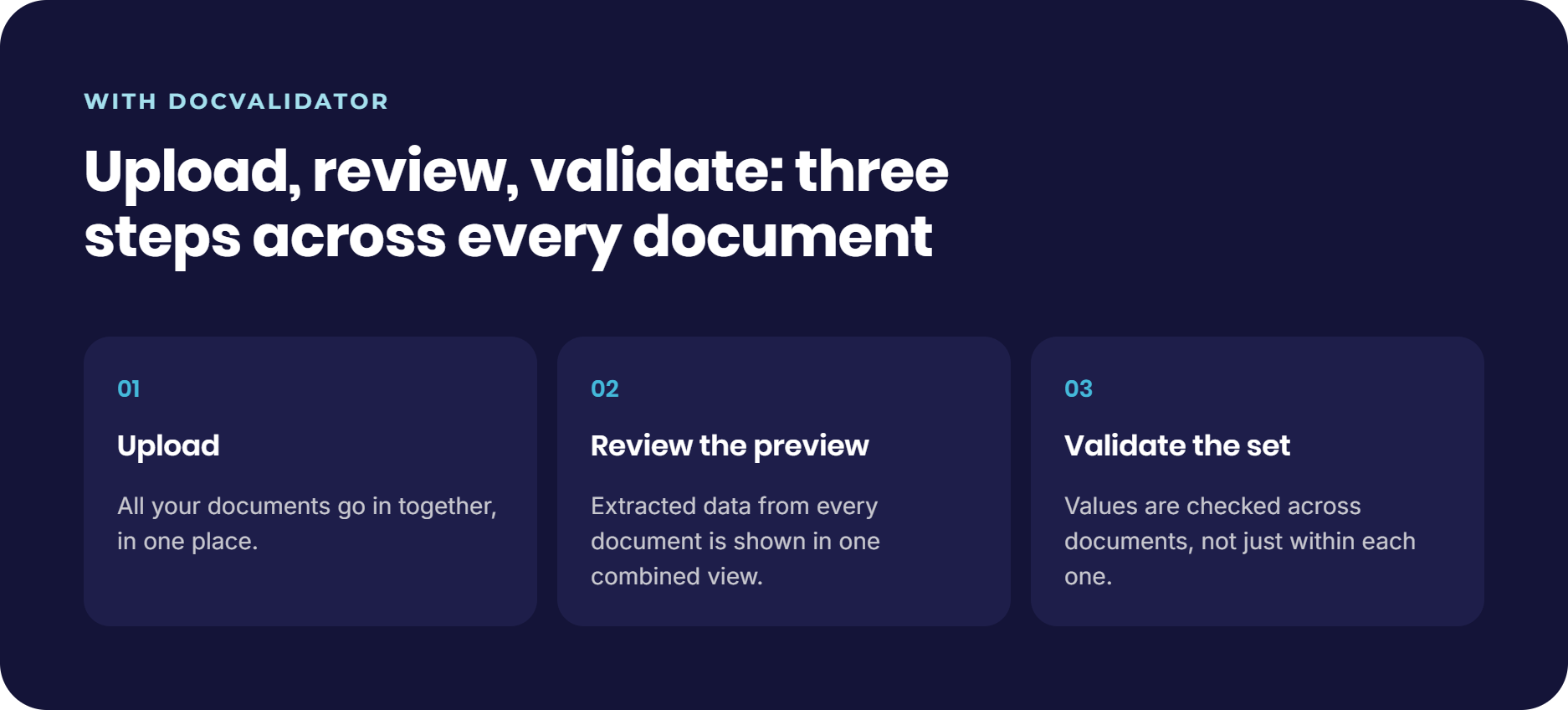
DocValidator, our Intelligent Document Validator, centralises and automates document consistency checks across the full order lifecycle. It replaces fragmented manual verification with a structured, intelligent validation workflow, so your team can stop cross-referencing files and start resolving the issues that genuinely matter.
Intelligent normalisation means fewer false alarms
Documents often express the same information in different ways. Without contextual understanding, a basic comparison tool would flag every one of those differences, burying your team in noise.
DocValidator's built-in normalisation rules recognise when differently formatted values mean the same thing. You can also customize these rules to fit your own business standards, such as your preferred currency codes, address conventions, date formats or commercial terminology, so validation follows the way your organisation actually works.
By recognising semantic equivalence, DocValidator reduces false exceptions and minimises manual follow-up. Your reviewers see the differences that are real, not the ones that are merely cosmetic.
Clear results your team can act on immediately
Validation results are presented in a clear, structured view. DocValidator verifies every field in the order and shows you exactly where you stand: the values that have been validated across all your documents, the values that conflict, and the values that are missing. Nothing has to be pieced together by hand.
This lets your team focus immediately on the exceptions that need attention rather than reviewing data that is already compliant. Each one can then be handled with confidence, whether that means confirming a value with a supplier, requesting a corrected document or holding a payment until the details are verified.
Built for phased deliveries
Real-world orders frequently ship in stages rather than all at once. Documentation can legitimately differ from one delivery to the next while still belonging to the same master order, and this is precisely where manual checks and simple comparison tools struggle.
DocValidator handles this complexity through lot-based validation. Users can define delivery lots and associate specific documents with each shipment phase. Each lot is then validated in the right context, so legitimate differences between shipments are not flagged as errors, and genuine discrepancies within a shipment are not lost among them.
Lot handling also understands batch fulfilment. A single large order, such as a bulk consignment of raw material, is often delivered as a series of smaller batches of different sizes, and DocValidator keeps every batch tied back to the original order quantity. A lot can contain multiple items, and the items for one lot can even be spread across several documents, for example when a single Certificate of Analysis (COA) has to be reconciled against more than one invoice or packing list. DocValidator brings those pieces together, so multiple documents and multiple lots are handled in one complete, connected validation rather than as separate checks.
Who DocValidator is for
DocValidator is built for importers and exporters, freight forwarders, customs brokers, shipping and container lines, and trade finance teams. Alongside invoice and packing list reconciliation, it supports bill of lading extraction from scanned and handwritten copies, customs declaration preparation with HS code and origin validation, certificate and permit checks, and checking presented documents against letter of credit terms.
The same challenge exists well beyond freight. Manufacturers, insurers, financial services firms and retailers all reconcile documents from multiple parties that describe a single transaction, and the same disciplined approach applies.
- Logistics and shipping teams can confirm quantities, delivery terms and addresses before documents go to carriers, banks or customs.
- Finance teams gain earlier visibility of pricing, currency and payment detail discrepancies before funds are committed.
- Compliance teams benefit from a structured, consistent check applied the same way to every order.
- Operations teams spend less time cross-referencing and more time resolving the exceptions that need their judgement.
Make Document Consistency Your Advantage
Whatever your industry, business is moving from paper to data, but that alone will not make your documents agree. Whenever orders, contracts, invoices, claims or delivery records are created by different parties in different systems, someone has to confirm they describe the same transaction. Today, that often depends on one experienced person with too little time.
DocValidator turns that personal diligence into a reliable, repeatable control. It brings every document into one view, lets your team confirm the data, checks 32 critical fields at once, filters out cosmetic differences and puts genuine exceptions front and centre, lot by lot.
DocValidator turns that personal diligence into a reliable, repeatable control. It brings every document into one view, lets your team confirm the data, checks every field that matters to you at once, filters out cosmetic differences and puts genuine exceptions front and centre, lot by lot.